

A Patternful Advent(ure)
The Pattern Matters

The season of Advent is upon us. Another year has rushed by and although a time where one should ideally slow down, it seems like there’s a mad rush and last hoorah at the end of the calendar year. The increasing heat here in the southern hemisphere also means beach vibes, sundowners and just overall good summer holiday fun. In the midst of all this good fun (and it is fun and good!), and the commercialism (not so good), it’s less easy to take a contemplative, patient step back than our fellow Northern Hemispherians with their short days and cosy fireplaces that just exude a contemplative aura.
Albeit less easy, it is not impossible, and Advent’s meaning luckily doesn’t depend on the weather. Christmas remains on the horizon too, which for sure is celebratory and where the summery days provide ample opportunities.
But as with most of our (modern) lives, we always want to jump to the feast before any sort of fast, which has become an anathema in the modern world, and boy do I struggle with fasting (and I don’t just mean food/drink fasting…my phone, for starters). So, I will attempt to imbibe Advent a bit better this year, including reading On the Incarnation1 by St Athanasius, the noted Egyptian Christian leader in the 4th century, because the claim of God becoming flesh and ushering in a new kind of life we can participate in, is quite the extravagant claim - not just a build-up to a saccharine birthday party for the babe from Bethlehem (or just an end-of-year party for my secular friends). If this claim is true, the incarnation is meant to be an anchor of reality, uniting not only heaven and earth, but also philosophy and theology.
I recently drew this little child-like advent(ure) infographic, inspired by an article by JP Marceau2 (needless to say, I am no artist - typically text-heavy, sigh):
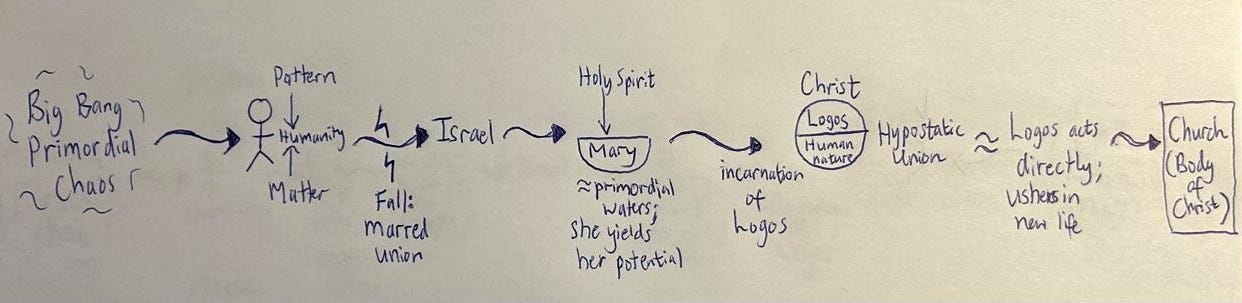
Essentially, this infographic attempts to show the Logos3 constraining creation over time (pattern meeting matter4) to the emergence of humanity, the Fall (marred union), the selection of Israel, whittling down to Mary, ultimately to the incarnation of Christ, where He can recreate the world directly through hypostatic union5, ushering in a new life we can participate in as His Body and becoming “sons”(patterns) of God, partakers of the divine nature. Mary, a key element in the Christmas story, is like the primordial waters (matter) in Genesis for the Pattern to be born. What happens between Mary and the Spirit is an icon of what happens in one person between the human and divine natures of Christ - the Logos reshapes creation through the human nature of Jesus, and we can be grafted into this journey and become participants in a cosmology of love. It’s like one big patternful Advent(ure) and we celebrate it fractally every year, whether winter or summer! Pretty neat and worthy of contemplation, even in the midst of hot summery festive sweats…
In a similar vein, the Renaissance artist Raphael’s most famous works - the Disputation of the Holy Sacrament and The School of Athens (both seen below) - are on opposite walls of each other in a room at the Vatican and includes the two famed Greek philosophers, Plato and Aristotle. Cameron Dixon6 writes that the philosophers are engaged in dialogue whilst holding their respective philosophical works - Plato holds his vertically whilst also pointing up and Aristotle holds it horizontally whilst pointing horizontally, indicating a tension in their metaphysics and the immaterial and material aspects of reality. Raphael has painted these scenes as if these two are walking towards the altar and thus alludes to the key to understand reality and relieve this tension - the Incarnation of the Logos, and by extension, the Eucharist (Communion). Also pretty neat and artistically so.
So, this year, let’s start to attempt to purposefully join in on this Patternful Advent(ure), be it on the beach or by the fireplace. Neat.


“In the Incarnation, the narrative world and the objective world meet and become one. In Christ, myth is made fact. Heaven and Earth touch. The spiritual world is married to the material world. Contained within the story of the Incarnation is the essence of all myths, all fairy-stories. Christ as the Master Pattern, the Logos, gathers all things, all stories, all myths, into Himself”
Link: On the Incarnation (book)
Article: Possibility, Intelligibility and the Incarnation by JP Marceau
A Greek term that refers to the Ordering Principle of the universe
Father (pater/pattern) meeting mother (matter/matrix/womb) typically results in new life
Christ’s human will fully follows and cooperates with Christ’s divine will within one person
Article: How the Incarnation answers Aristotle and Plato - Part 1 by Cameron Dixon