

The Way of Beauty: Part 2
Part 2: Cruciform Beauty

[To make the initial lengthy contemplation more digestible, this is Part 2]
Cruciform Beauty
Now some might evoke the Crucifixion of Christ in counter to the previous musing on Beauty (Part 1), which early Christians themselves had difficulty to depict due to the humiliating and violent nature thereof. Where’s the beauty in this violent aspect of Christianity? Sure, the subsequent Resurrection is a beautiful “ending”, so to speak, and equally so a salvation story where God brings us home rather than us having to earn salvation and carry the burden of creating our own identities and meaning. However, why such a cruel death and why did Jesus have to “die for our sins”? Can the cross tell us something about Beauty and the embodiment thereof? And what about Isaiah 53:2 that states that,
“He had no beauty or majesty to attract us to him, nothing in his appearance that we should desire him.”
Firstly, as Gregory Wolfe states, the ancient Greeks thought deeply about Beauty, but the notion of cruciform beauty, especially in relation to God or gods, would have caught them and the Romans off-guard, as probably would most other cultures. He states,
“The Greeks were deeply divided about beauty - they loved harmony, proportion, symmetry, the ideal form, but they also knew darkness, as their tragedies attest. To my mind, a deeper understanding of beauty came into being with Christianity - the cross, the instrument of torture and shame, was taken up into a higher vision of beauty. Brokenness and woundedness - the shattering of the ideal - can become the means whereby beauty is revealed. Here is a beauty that is anything but sentimental.”
Some readers might be aware of the Christian atonement theories brought about by the crucifixion, and depending on your specific Christian church tradition, some might have been emphasised more than others and perhaps to the detriment of others. There has been much theological reflection on this mystery (and the word mystery does not mean unexplainable, but more of a sense of layered meanings that can be revealed and mined). I’m no theologian, priest or pastor, so best not for me to delve into this mystery and one can read about these elsewhere or consult your priest or pastor; however, given that perhaps many of us were mainly exposed to a potentially over-emphasised penal substitutionary atonement theory, I found it helpful to explore the greater ontological mystery of the cross where Christ assumes our human nature and as Fr Stephen Freeman states1,
“Unites Himself with man (the Incarnation) and in so doing takes upon Himself, and into Himself the fullness of our humanity, excepting sin, which is foreign to our true nature. Importantly, however, just as Christ takes upon Himself our humanity, so He also unites Himself to us, we take on His divinity. As God and as man Christ enters death, Hades, the full consequence of our separation from God. As God and as man, Christ destroys death and unites man victoriously to His resurrection. He is the true mediator, having restored us to the union with God for which we were created.”
If so inclined, you can read further by clicking here, including the comments, which always provide for good debate and clarification. I’m still exploring all of this myself.
Of course, there is also sacrificiality at play here that fulfills the sacrificial system of the Old Testament and other cultures, but it also points to the cruciform nature of reality. The crucifixion of Christ, the new Adam, brings forth the new Eve, the church, from His spear-pierced ribs (John 19:34) just as the Genesis story states that Eve was brought forth from Adams side. As Peter Leithart describes2,
“Sacrifice is built into the structures of creation and undergirds history. Creation is a sacrificial procedure.
Division to reunion, death to resurrection, grave to glory - that’s the way the world comes to be and the way the world works. It’s the sacrificial movement of creation, life and history. Sacrificial liturgy doesn’t introduce an alien pattern into the world, it runs along the grain of a sacrificial cosmos.”
As Fr Stephen Freeman further describes, purely moral imagery can tend towards seeing the world as disconnected - that we are simply a collection of independent moral agents being judged on our behaviour and what I do and you do is not really connected, but in reality, we all share in the commonality of created being, which also makes me think about the African concept of Ubuntu meaning “I am because we are”. There is true communion at the root of existence - a multidimensional, multifractal ontological tapestry of communion, and struggle, and love, and falling, and loss, and sacrifice, and resurrection. Through Christ, we don’t just become mere rule-abiding but get infused with agency to become more like God, we become beautified and in Him we “live, move and have our being” (Acts 17:28). And there is no communion without a sacrificial disposition towards the other, so a cruciform beauty is required that, as Dr Timothy Patitsas describes,
“Bears Christ crucified within it and evoking within us the mature and complete readiness to carry our cross for the life of the world and to become transfigured and beautified through Christ”
The whole is always greater than the sum of its parts - when one part starts to dominate and take over the whole, it becomes cancerous and disproportional (just like real-life cancer or an ideology), so we need a mutual sacrificial indwelling, a Trinitarian indwelling, where the parts have a disposition of self-emptying love as opposed to an atomised, self-serving disposition. Even in the context of the family, for example, this sacrificial disposition is embodied in the caring for children.
Interestingly, as Makoto Fujimura states in his insightful book Silence & Beauty, which explores various Christian themes in the awarding-winning book and Martin Scorsese film Silence,
“Japanese philosopher Tomonobu Imamichi, who studied aesthetics and Chinese philosophy compared beauty and goodness and considered beauty to be the more transcendent of the two. The Japanese ideogram of “goodness” (善) is made up of two ideograms: one of a sacrificial “sheep” on top of an ideogram of a “box”. To be good, it is only necessary to fulfill pre-determined sacrifice determined by society: paying taxes or participating in traditions, rituals etc. The ideogram of “righteousness” (義) is made up of the ideograms of sacrificial “sheep” on top of the ideogram of “self”. It means to carry the sacrifices yourself. But the ideogram of “beauty” (美) is made up of the sacrificial sheep on top of an ideogram for “great”, which he inferred means “greater sheep” - a greater sacrifice. This greater sacrifice may require sacrifice of one’s own life to save the lives of others. This sacrifice originates from self-initiative, a willing sacrifice. This is what is truly beautiful.”
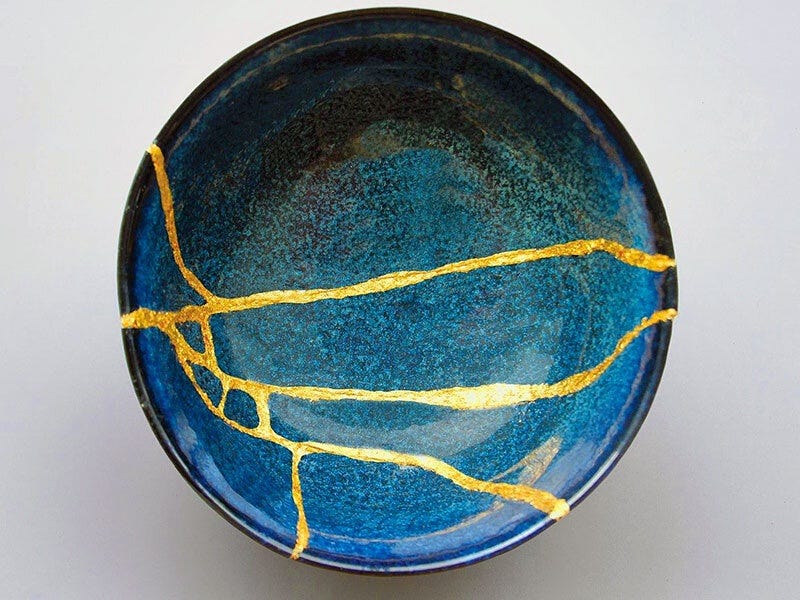
Christ willing went to the cross for the “life of the world” and to re-commune humanity through His resurrection - He was the willing sacrificial lamb. And as the book further alludes to, this effects a Kintsugi Beauty, where Kintsugi is the Japanese art of repairing broken pottery with lacquer dusted or mixed with powdered gold, silver, or platinum. Christ effects this kintsugi and even with our own wounds and sufferings, we radiate like the kintsugi bowl, just like Christ did with His.
A personal experience that comes to mind in relation to this took place in a famous Catholic church in Soweto, South Africa, called Regina Mundi, which played pivotal role in the struggle against Apartheid (interestingly, a peace pole was donated and erected in front of the church by Japanese Christians if I recall correctly). It housed many political meetings, and TRC3 meetings after Apartheid, and many students took refuge there during the Soweto uprisings of 1976. In any case, I attended a US-RSA collaborative concert here and the likes of Beethoven's 9th symphony, Bawo Thixo Somandla (Father, God Almighty) and a classical rendition of Shosholoza was played and sung - German, Sotho, English, Zulu and isiXhosa. To be present in such a historically pivotal place, together with the local community (with some having never had the opportunity to attend such an event) and listening to such beauty was sublime. The evidence of bullets fired by the police inside the church during the uprisings could still be seen on the sculpture of Christ hanging on the crucifix behind the orchestra and choir - only three fingers on the right hand. The altar table is also, to this day, still damaged but in use for communion. To me this depicted such a hopeful cruciform, kintsugi beauty.
This notion of cruciform beauty is also the antidote to deceptive beauty, especially since beauty without truth is a lie. Maria Skobstova, a Russian noblewoman-turned-Orthodox-nun in the 20th century and a member of the French Resistance in World War II who died in a gas chamber in a concentration camp, warned of being aesthetically swooned. She stated,
“We cannot see the Church as a sort of aesthetic perfection and limit ourselves to aesthetic swooning - our God-given freedoms call us to activity and struggle…and there you feel an unappeasable hunger for Christ’s truth. There, instead of becoming lukewarm, you will be set on fire; instead of pacified, you will become alarmed; instead of learning the wisdom of this world you will become fools for Christ.”
A scene from one of my favourite films, A Hidden Life, also speaks to this challenge and is a film which I will be exploring in a separate post as it is truly a monumental painting in motion. Here’s the clip:
This film depicts a conscientious objector in the Nazi era - a group who most probably also listened to classical music, a manifestation of human capability and beauty; however, they missed the cruciform nature of beauty and the call to carry our crosses, to see the imagio dei, the image of God, in their neighbour and sacrificially and mutually indwell together, reflecting the divine life of the Trinity and the cruciform love of Christ. They missed the antidote to deceptive beauty. They missed Christ and imbibed the anti-Christ.
As Brian Zahnd says in his book The Wood Between the Worlds,
“[The Crucifixion] is the pinnacle of divine disclosure, the eternal moment of forgiveness, divine solidarity with human suffering, the enduring model of discipleship, the supreme demonstration of divine love, the beauty that saves the world, the re-founding of the world around an axis of love, the overthrow of satan, the shaming of the principalities and powers, the unmasking of mob violence, the condemnation of state violence, the exposé of political power, the abolition of war, the sacrifice to end sacrificing, the great divide of humankind, the healing center of the cosmos, the death by which death is conquered, the Lamb upon the throne, the tree of life recovered and revealed.”
Next is Part 3: Perception and Knowing.
Therapeutic Substitutionary Atonement, Fr Stephen Freeman
Theopolitan Liturgy, Peter Leithart
Truth and Reconciliation Commission